Driving Question
What drives us to innovate?
Big Idea
Access to water for human needs may require us to use natural forces or engineered solutions, or both. As cities like Philadelphia grew from a small colonial settlements to bustling cultural, social and commercial centers, along came the ingenuity and desire to meet everyone’s water needs with a common/public water system.
In the 1700s , people living in Philadelphia accessed their drinking water from ground using deeply dug wells and pumps to bring it to the surface. To bring well water to the surface, a handle or lever connected to a piston rod inside a pipe ,that sucked water in and up. This back and forth action of the piston was possible by a connected lever or handle that made the mechanism go up and down. This required human energy to make this work – Let’s give that a try!~
Summary
In the early colonial settlement of Philadelphia by William Penn, population was low, houses were set apart and the impact from industry was minimal on the land. When choosing a source for drinking water, groundwater was the best option at the time, because of the natural filtration benefits of soil as water percolates through the soil. The method for getting ground water to the surface for use was the use of a simple pump, powered by humans. Pumping water from a low spot to a high spot takes a bit of work. We will use our own energy to make water flow from a low spot to a high spot. Is this hard for you to do (every day ?) This might require visiting a pump shared by many households, filling a bucket and carrying it home. One bucket may not last very long and so this might need to be repeated more than once a day or every day (or it might make you use what you have carefully).
In this lesson, students will make a simple pump that pushes water from a low spot to high spot using their own “power”.
Using Hand Pumps for Groundwater Access
In the early colonial settlement of Philadelphia by William Penn, population was low, houses were set apart and the impact from industry was minimal on the land. When choosing a source for drinking water, groundwater was the best option at the time, because of the natural filtration benefits of soil as water percolates through the soil. The method for getting ground water to the surface for use was the use of a simple pump, powered by humans. Pumping water from a low spot to a high spot takes a bit of work. We will use our own energy to make water flow from a low spot to a high spot. Is this hard for you to do ? Every day ? This might require visiting a pump shared by many households, filling a bucket and carrying it home. One bucket may not last very long and so this might need to be repeated frequently (or it might make you use what you have carefully).
Teacher- background and instructional narrative
Groundwater is generally the cleanest source of water because of the natural filtration benefits of soil as water percolates through the soil. That is why , if you are living in a generally uncontaminated area (low population density, little farming or industrial waste). Explore the colonial era Wood-stock Water pump like this one from the Peter Wentz Farmstead in Worcester PA just outside of Philadelphia. Some mechanical forces were needed to construct the pump but, once installed, it was human energy that brought water to flow into a side spigot and into a bucket or trough.
Have your students make a hand pump. Ask them to note how much force you need to get the water from one place to another . Is there another pump that like this that might be analogous – a bicycle pump to fill a flat tire requires some human energy to force the air into the tire.
Discuss what other kinds of power besides their own muscles could help make their job easier? The next lesson in this series will introduce water power and gravity which together were used to make Philadelphia’s first public water system.
Materials
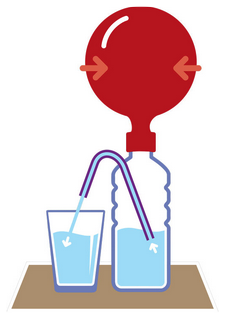
An empty plastic water bottle. Using a clear bottle allows everyone to see the pump in action!
- A balloon.
- A straw (bendable straws work best).
- Glue or tape.
- Water.
- Scissors.
- A container to catch the water being pumped.
Instructions
- Use scissors to cut a small hole near the top of the bottle. (Adult help is needed for this step!)
- Place the straw through the hole. Glue or tape the straw into place and try to cover up any gaps around the hole to prevent air or water from escaping.
- Fill the bottle with water about three-fourths of the way.
- Place the bottle beside the empty bowl. Position the straw to empty the water into the bowl.
- Inflate the balloon and hold it closed.
- While keeping the balloon pinched closed, wrap the bottom of the balloon around the lid of the water bottle.
- Slowly release your fingers from the balloon, allowing air to escape into the bottle.
- Watch as water flows out of the bottle and into the bowl!
- Repeat as desired.
Assessment
Ask students to describe how people in colonial times in Philadelphia managed access to drinking water differently from today. They can draw a split picture of themselves as a then and now, showing themselves accessing water. Caption the drawing or write two short paragraph descriptions.
Teacher Support
Driving Question:
What drives us to innovate?
Guiding Question:
How do humans engineer a system to make access more reliable and efficient? Engineering access to water (source, developing infrastructure using nature (gravity, water wheels to drive pumps)
In this lesson, students will make a simple pump that pushes water from a low spot to high spot using their own “power”.
An empty plastic water bottle. Using a clear bottle allows everyone to see the pump in action!
- A balloon.
- A straw (bendable straws work best).
- Glue or tape.
- Water.
- Scissors.
- A container to catch the water being pumped.
Pump (noun) a mechanical device using suction or pressure to raise or move liquid, compress gases or force air into inflatable objects such as tires
Piston (noun) a disk or short cylinder fitting closely within a tube in which it moves up and down against a liquid or gas, used in a pump to impart motion.
Ask students to describe how people in colonial times in Philadelphia managed access to drinking water differently from today.
Students can create and label a diagram of how the water pump works as an engineered solution.
PA STEELS Standards
3.4 Environmental Literacy and Sustainability
Agricultural and Environmental Systems and Resources
3.4.6-8.B Environment and Society: Analyze and interpret data about how different societies (economic and social systems) and cultures use and manage natural resources differently.
3.5 Technology & Engineering
Influence of Society on Technological Development
3.5.6-8.G Impacts of Technology: Analyze how an invention or innovation was influenced by the context and circumstances in which it is developed.